
Future of Education: AI in Teaching

Remember Sunday night grading? That stack of papers you swore you would finish before dinner - and then did not. AI will not fix every part of that ritual. But when you use it well, it can cut busywork, speed up feedback, and help you meet students where they are while you stay in charge of the goals, the relationships, and the final call.
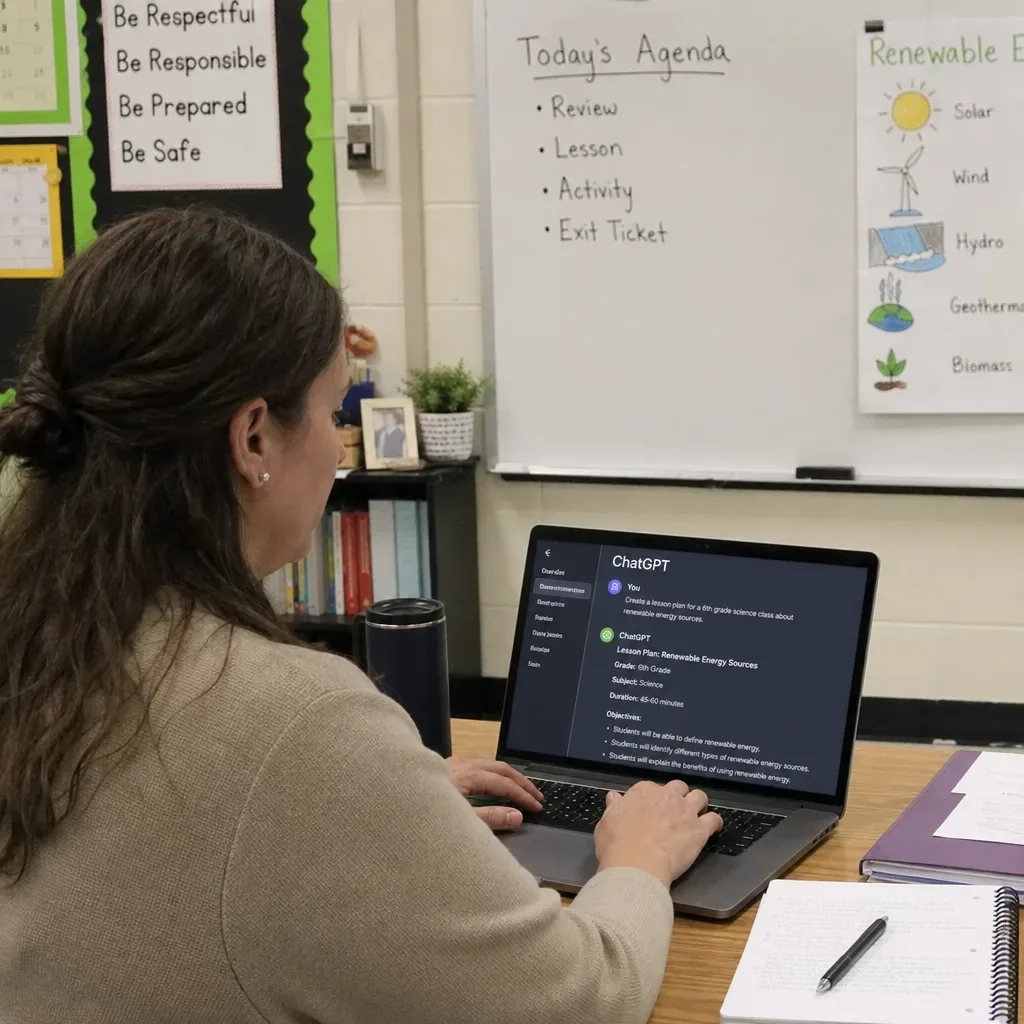
What is AI for teachers?
AI for teachers is a broad label for tools that can write, summarize, sort, or spot patterns. In schools, it mostly shows up as support for planning, differentiation, grading, and feedback. Think of it as an assistant that produces drafts and suggestions - not a replacement for teaching.
- Planning: lesson outlines, examples, discussion questions
- Differentiation: leveled texts, scaffolds, alternate formats
- Grading support: first-pass sorting, rubric-aligned notes
- Communication: summaries for families, progress updates

How AI is already changing the classroom
The biggest gains so far come from small wins - faster prep, faster iteration, and quicker feedback. Many teachers use ai prompts for teachers to get a first draft, then edit for their standards, student needs, and local policy.
Common use cases include:
- AI worksheet generator for teachers workflows (exit tickets, practice sets, differentiated versions)
- Sentence stems and exemplars for writing
- Small-group plans based on patterns in student work
- Draft feedback aligned to a rubric

AI prompts, worksheets, and student feedback (without sounding generic)
Better prompts lead to better results. Include the grade level, standard, time limit, and materials students will have - not student names, IEP details, disability labels, grades tied to a specific student, or parent contact info. Names can skew AI output and create FERPA risk. Describe the learning need generically, then review before you share.
For student feedback, AI can help you move faster by:
- Summarizing strengths in rubric language
- Suggesting one specific next step (not a long paragraph)
- Generating conferencing questions for common misconceptions
Here is the catch: generic AI feedback reads like it was written for everyone, which means it was. Your students deserve comments that sound like you know them. Use AI to draft, then edit for voice, context, and the one detail only you would notice. If report card season is what you are dreading, we go deeper on that in writing report card comments that do not all sound the same.
AI grading tools: what works (and what does not)
AI grading for teachers can help with quick, consistent checks - especially when criteria are clear. But for essays and complex reasoning, it works best as an assistant. You still need to review and make the final call.
Where digital grading AI can help:
- First-pass sorting (meets / approaches / does not meet)
- Spotting missing parts (claim, evidence, explanation, citations)
- Drafting feedback you can accept, edit, or reject
Where it can go wrong:
- Unfair results if rubrics or training data do not fit your task
- Missing context, creativity, or student intent
- Confident-sounding mistakes
That last one matters more than people admit. Language models are trained to sound authoritative - even when they are wrong. A polished but incorrect grade justification can slip past you at 10pm if you are tired. Treat every AI score as a draft, not a verdict.
Grading is also only one link in a longer chain. If you want to see how scores, rubrics, comments, and the finished document fit together, our guide to creating full report cards with AI walks the whole pipeline stage by stage.

For a clear way to think about AI risks and safeguards, see the NIST AI Risk Management Framework.
Where the line is: AI can handle the repetitive 80% - flagging missing citations, checking rubric alignment, drafting a first pass of feedback. You handle the 20% that actually needs a human: knowing that Marcus wrote worse than usual because his parents are going through a divorce, or that Priya's stiff formal tone is real growth from September. The correct use of AI in your gradebook is not "let it grade for you." It is "let it do the repetitive work so you have energy left for the parts that matter."
AI for special education teachers: where it can help
For ai for special education teachers, AI can make differentiation faster. It can also create more ways for students to access the same concept. The key is making sure it matches IEP goals and is accessible and safe to use.
Useful supports include:
- Simplified text and step-by-step directions
- Practice in smaller chunks with clear models
- Adapted assignments that still align to standards
When choosing ai tools for special education teachers, align decisions with district policy and applicable requirements (see IDEA resources).
How do teachers check for AI? Academic integrity in the age of chatbots
Detection tools can help, but they are not reliable enough to use alone. A stronger approach combines clear rules, evidence of process, and assessments that make thinking visible.
- Ask for outlines, drafts, notes, reflections, or version history
- Use short in-class checkpoints
- Do quick oral follow-ups: "Explain why you chose this evidence."
If you use detectors, treat them as one signal among many and follow your school's process. For example, see Turnitin AI writing detection for product-specific guidance and limitations.
Choosing and rolling out AI tools (especially for grading)
If you are evaluating an ai grader for teachers, a free ai essay grader for teachers, or broader ai grading tools for teachers, prioritize transparency, data handling, and teacher override. Pilot with a small group, compare results to human scoring, and document when the tool helps and when it does not.
For broader ethics and governance context, see UNESCO's Recommendation on the Ethics of AI.
Data privacy, bias, and guardrails
AI needs guardrails: what data is allowed, who can see it, and how decisions are reviewed. In the U.S., many districts ground privacy decisions in FERPA (see U.S. Department of Education FERPA guidance).
- Do not paste sensitive student info into general AI tools
- Require human review for high-stakes decisions
- Check outputs for bias and accessibility impacts
AI tools for teachers 2026: what to expect
By 2026, expect AI to be more tightly built into tools teachers already use (LMS, gradebooks, assessment platforms). The schools that benefit most will treat AI like infrastructure: training, clear policy, and ongoing evaluation - not a one-time rollout.
Conclusion: what AI can and can not do for teachers
AI can help you move faster on planning, grading, and feedback, and it can expand options for differentiation. But it cannot replace relationships, professional judgment, or the human work of motivating learners. The best approach is AI-assisted teaching: teachers lead, AI supports, and guardrails protect students.
Start small - one class, one workflow, one prep period. See what actually saves you time without cutting corners on learning.
If you want to go deeper on a specific workflow, these are the practical next steps: the full report card pipeline, writing report card comments with AI, and - if you teach at home - building a homeschool gradebook. If you just want somewhere to put the scores, take our free Google Sheets gradebook template.